The Numbered Military Post Offices -- in 3 Volumes
Hello, I'm the /base/pb_apo7/index.md
Introduction
The 7th Edition of the Military Postal History Society’s listings of military post offices is now available. Due to the amount of new information since the last edition, the book has been split into several volumes.
by Russ Carter
- - - -
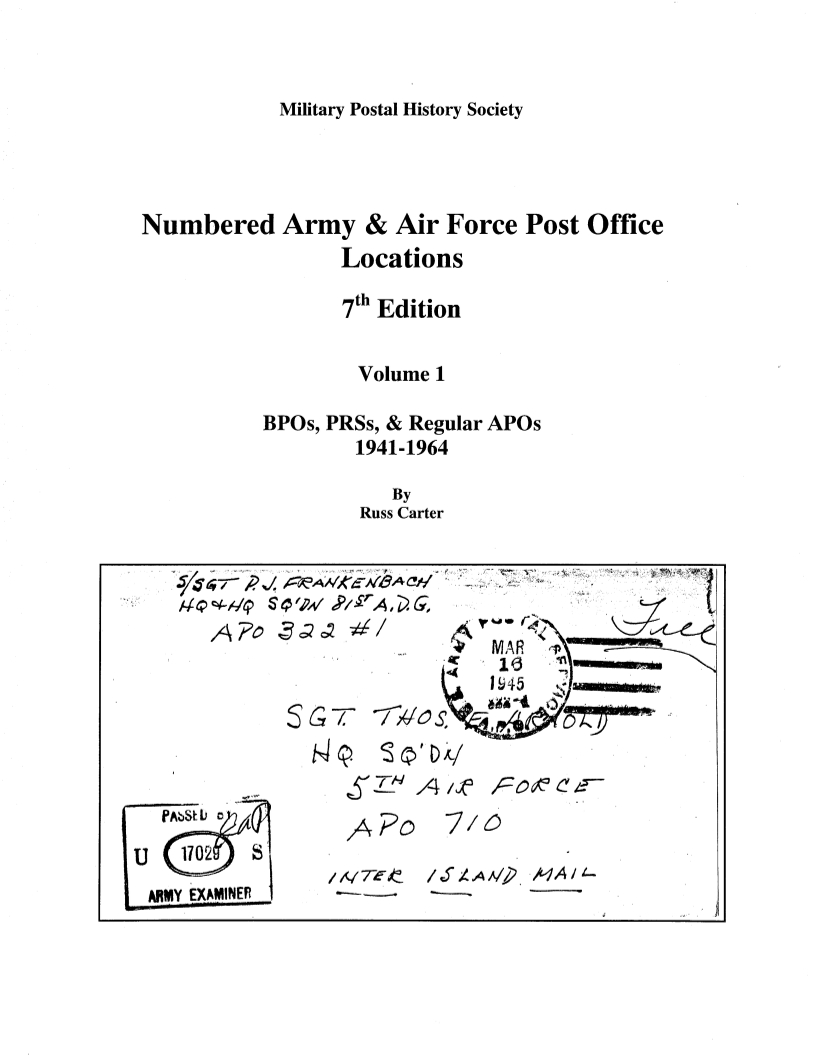
Title Page
Vol 1
This, the first of these volumes, deals only with the numbered permanent Army post offices from World War II until the start of the ZIP era. Many corrections have been made in this edition. The large number of additions is the result of extensive research in the National Archives and the Center For Military History along with the input from Society members.
Besides many new dates and locations, there are entries for APOs previously not known along with previously many unrecorded branches.
Some examples are: the previous edition had 34 Base Post Office entries while the new edition has 88 entries plus information on BPO detachments; the 1st BPO which had 2 lines now lists 25 lines and now known to be 3 different units; APO 196, which was on a ship, was listed with 5 locations and now lists 12 locations; APO 999, which previously had 4 sub unit entries now has 16 entries Changes and additions to Canadian, Alaskan, and Central American APOs is especially strong.
Many new APOs in India and post war Germany have been added. The section on APOs % PM Los Angeles is the most comprehensive and detailed listing ever published.
The book opens with an introductory chapter on the history of the Army Postal System, and how it worked with such things as listings of APOs used in US maneuvers, lists to help identify covers, and a description of the relationships between the pans of the Post Office Department and the Army. Next are chapters on the Base Post offices and Postal Regulating Stations with their histories, workings, and listings. The main body of work, over 240 pages, is the chapter on APOs with their listings And finally a country index of numbers listed.
The book is 321 numbered pages with 23 illustrations and 7 charts. It is 8.5 by 11 inches loose leaf and 3 hole punched.
- - - -
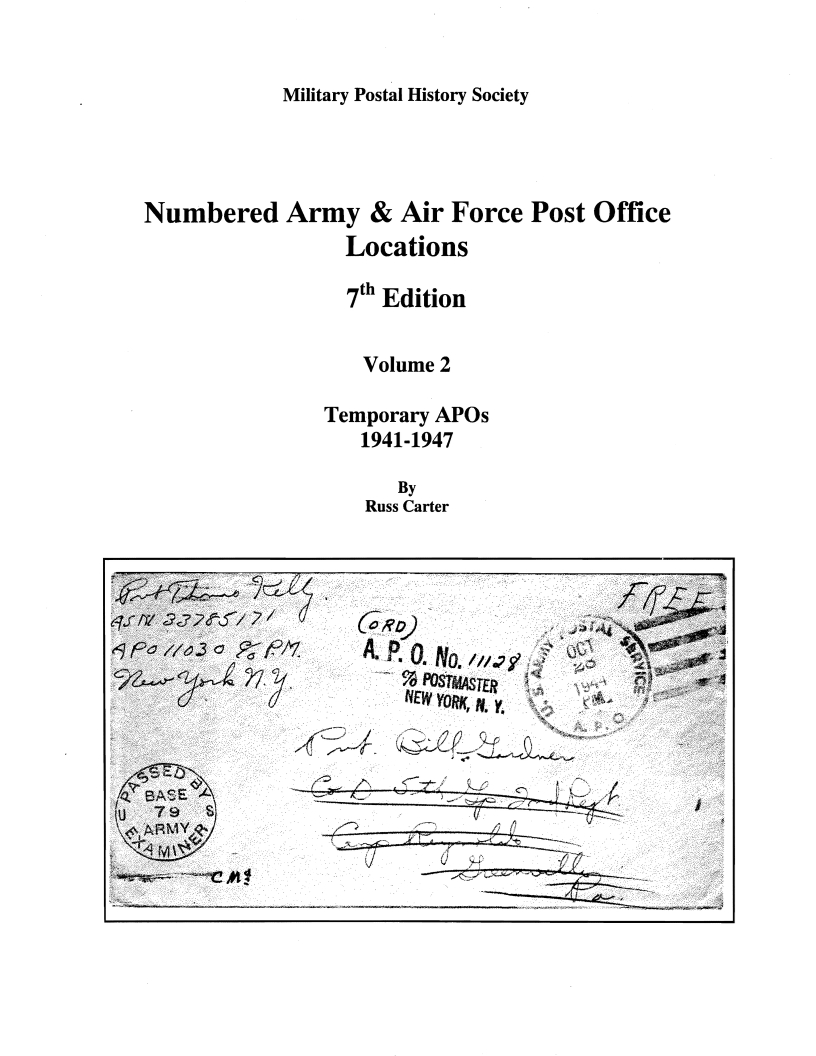
Title Page
Vol 2
Almost nothing in military cover collecting is as mysterious as those 4 and 5 digit APO numbers. There have been questions on what they were called, how they worked, who got them, and where they were or went. The previous edition of this book listed about 600 of these APOs but was little more than a listing from couple of cover collections. So much new information has been gathered that a whole volume was required.
This volume is the culmination of several years’ research in the National Archives and lists over 21,000 numbers. Most of these numbers list the date they were assigned and where they were going. The story begins with the first assignment in December 1941 to the last one recorded in April 1947. There are sample documents to show not only the source of the information but also how the system worked. Included, for example, is a document assigning a temporary APO to comedian Jack Benny.
The volume takes you through each feature of a temporary APO and tells who used them and why, how many people used them, where they were used, and so forth. Of particular interest is information on how to decipher a cover: what numbers were set-aside for special purposes and what the suffixes or letters and additional numbers meant. Along with this, one will find what it means when a cover is or is not censored, why Navy cancels are on some covers, and how to figure out where a cover was posted when there is only a killer cancel or no cancels.
The book is 417 numbered pages with 17 illustrations, 9 documents, and 1 chart. It is 8.5 by 11 inches loose leaf and 3 hole punched.
- - - -
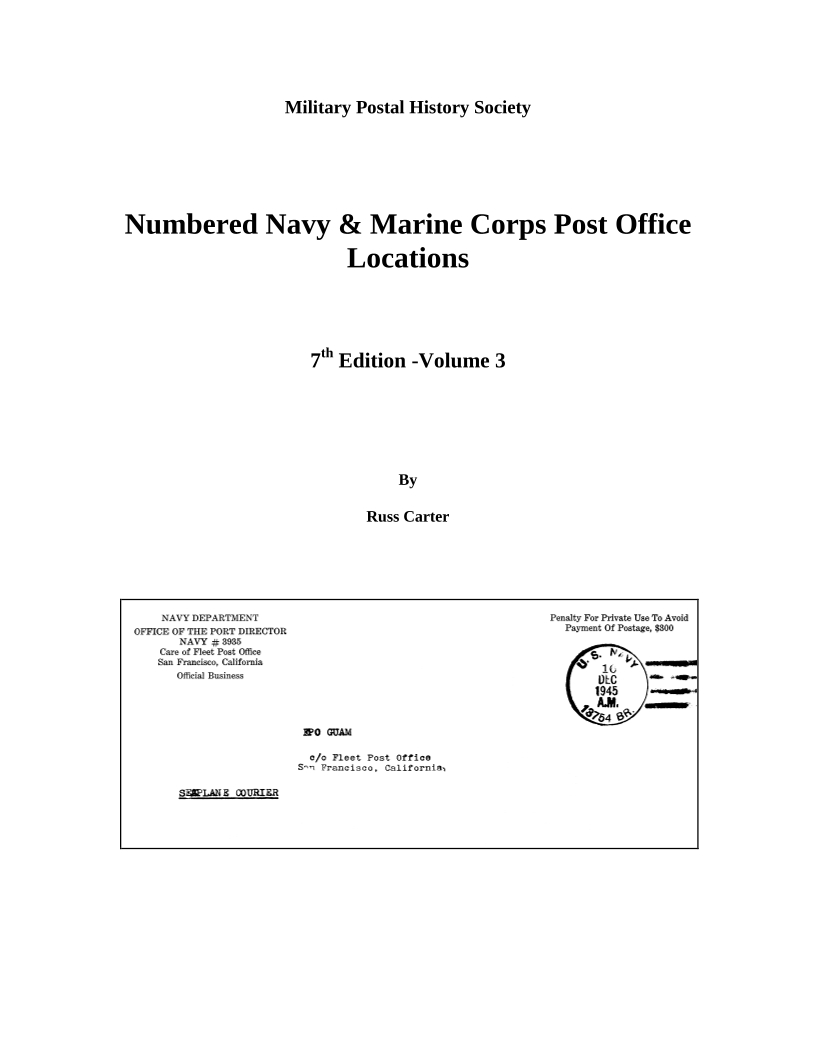
Title Page
Vol 3
The numbered Post Office codes used by the Navy, Coast Guard and Marine Corps were an attempt to hide the locations or unit type. This volume is the culmination of several years’ research in the national Archives and U.S. Postal Service library to try to fill gaps of previous editions.
While there are a good number of newly discovered Post Office numbers, the real contribution of this edition is the thousands of added locations to Branch locations.
This book begins with an introduction to the Navy and Marine Corps postal coded numbering systems. It is followed with a detailed listing of Navy Post Office numbers, then by the Branch numbers used by the Navy, Coast Guard and Marine Corps and finally a listing of the Marine Corps Unit numbers that was used early in WW II. Each section contains illustrations of both common covers and a few oddities created by the numbering systems. Last but not least, the numbers and the countries in which they were used are included.
This study has 287 pages and includes 37 illustrations.
Additional Links
Anyone may order paper copies of this book from the APS. See: this APS page. (APS members receive a discount when ordering.)PDF (electronic) copies of this book can be ordered from the MPHS (You must be a member to order the e-book version.)
Search for all MPHS publications using the "finder" web page set at this link.
Information on all MPHS publications
Back to Main MPHS Page
Technical Information
Website Created with HUGO using no theme
Content Updated
Sun 06 Sep 2026 11:23:07 AM CDT